Existing Pain Points of Traditional Manual Slope Weeding
1. Significant Safety Hazards
Working on steep slopes is unstable, and wet surfaces after rain can easily cause slips and falls; wild poisonous snakes, mosquitoes, and falling rocks pose constant threats to maintenance personnel's safety.
2. Low Operational Efficiency
Manual carrying limits mobility, resulting in small working areas per session. For large slopes, the weeding cycle is lengthy, failing to keep up with weed growth, significantly compromising maintenance effectiveness.
3. High Labor Costs
There is a shortage of young labor in mountainous areas, and it is difficult to recruit skilled maintenance workers, with wages increasing year by year. Long-term reliance on manual labor significantly raises overall landscaping and maintenance expenses.
4. Severe Terrain Limitations
Gullies, narrow spacing, and limited space below photovoltaic panels make turning difficult for personnel. Conventional equipment cannot access these areas, resulting in rough clearing and incomplete weeding.
Practical Implementation Case
A municipal highway maintenance unit is responsible for maintaining dozens of kilometers of highway slopes and mountainous green belts in its region. In past years, weeds grew rapidly after the rainy season, requiring temporary hiring of a large number of workers to cut grass in sections up the hills. Annual labor costs were high, and safety accidents occurred occasionally.
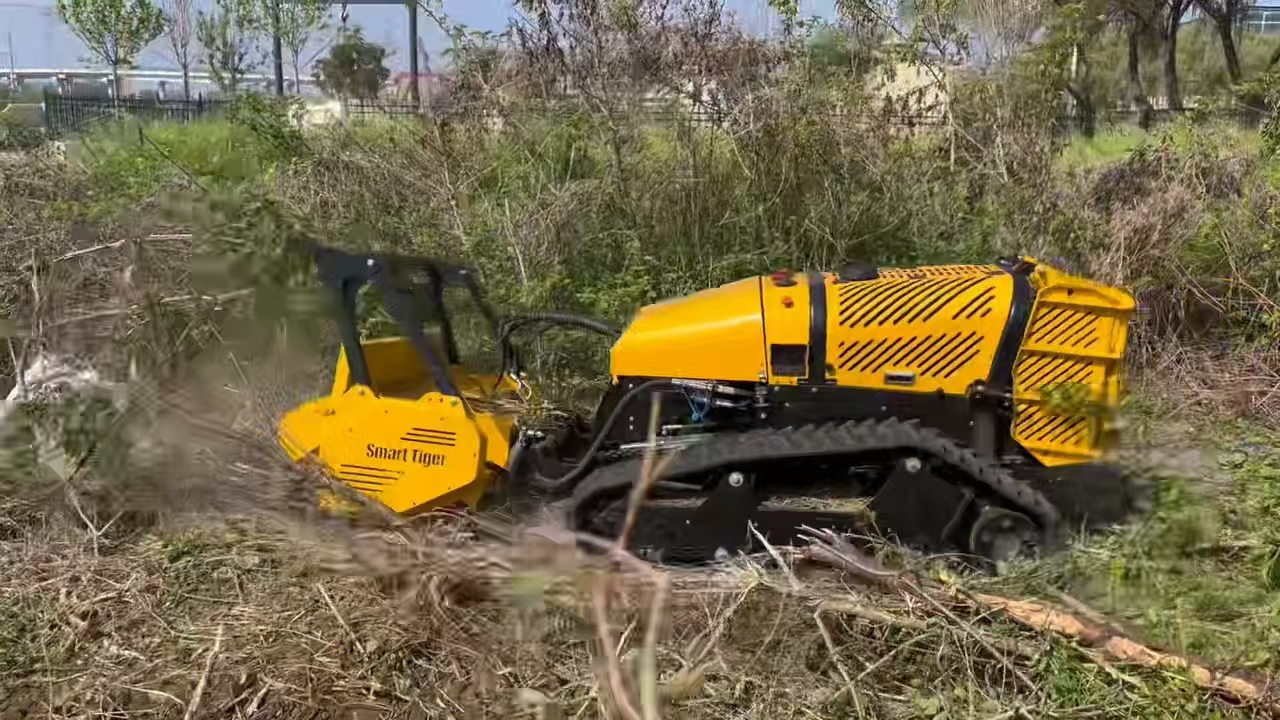
To thoroughly address safety and cost issues, the project introduced multiple remote-controlled tracked all-terrain mowers for regular operations. The practical results are as follows:
1. Long-Distance Remote Control, Zero High-Risk Operations
Operators stay in flat, safe areas holding a remote control, maneuvering the equipment wirelessly within a range of hundreds of meters to move, turn, start, and stop. Equipped with a one-button emergency stop function, accidental risks are eliminated, freeing personnel from having to step onto steep slopes.
2. Tracked Strong Grip, Stable Navigation on Large Slopes
The widened, anti-slip steel track chassis has low ground pressure, preventing sinking on muddy or soft slopes. It can handle operations on slopes up to 45°, and traverse mountains, riverbanks, and uneven wasteland smoothly.
3. Multi-Purpose Machine, Adaptable to Various Maintenance Scenarios
Adjustable cutting height enables uniform slope trimming for municipal areas. In orchards, lower cutting width allows movement between trees while chopping grass for simultaneous return to the soil without damaging seedlings' roots. In photovoltaic fields, the low-profile machine can move freely under panels without impacting photovoltaic components.
4. Double Efficiency, Long-Term Cost Savings
A single machine covers more area daily than multiple laborers, completing weeding and mulching in one pass without requiring secondary removal. Annual calculations show significant labor cost reductions and a short equipment payback period.
No need for people to weed steep slopes, the tracked remote-controlled lawn mower solves dangerous work problems
Weeds growing out of control on highway slopes, mountainsides, riverbanks, mountain orchards, and steep areas of solar farms have always been a headache for the landscaping and maintenance industry. Traditional manual work with backpack mowers on steep terrain faces multiple issues like steep slopes, slipping and falling, mosquitoes and loose rocks, and rising labor costs year by year. With the spread of mechanized maintenance, all-terrain remote-controlled tracked mowers are gradually replacing risky manual labor, becoming the go-to solution for weeding steep slopes, clearing wasteland, and managing farmland and forests.
Project Details
About This Case
2026-06-14
If you are interested in this solution or have similar needs, please contact our expert team.
Request Quote