In city greening projects, orchard expansions, seedling bases, and forest farm renovation projects, transplanting large trees and digging seedlings with soil balls are key construction steps. Traditional manual work with shovels is time-consuming and labor-intensive, with high soil ball breakage rates and severe root pulling, resulting in low survival rates after transplanting. At the same time, rising labor costs and shortages of skilled workers have become common pain points in the seedling industry. With the popularization of landscaping machinery, tracked tree diggers are gradually replacing manual labor, achieving standardized, efficient soil-ball digging and being widely used in nurseries, municipal greening, and barren hill afforestation scenarios.
Pain points of traditional manual tree digging
1. Very low construction efficiency
Manual digging around and shaping the soil ball limits the amount a single person can dig in a day, which easily delays large-scale greening projects.
2. Poor soil ball formation, survival rate is worrying
Manual digging applies uneven force, causing cracks and crumbly soil balls, damaging fine roots. Long-distance transplanting slows seedling growth and increases mortality rates.
3. High labor cost pressure
Heavy-duty tree work is hard to recruit for. During peak seasons, temporary labor prices fluctuate significantly, and long-term reliance on manual labor drives up overall construction budgets.
4. Restricted by terrain
Mountainous or sloping areas and soft nursery soil easily collapse. Manual standing operations are unstable, and work on steep slopes is unsafe.
Real project application case
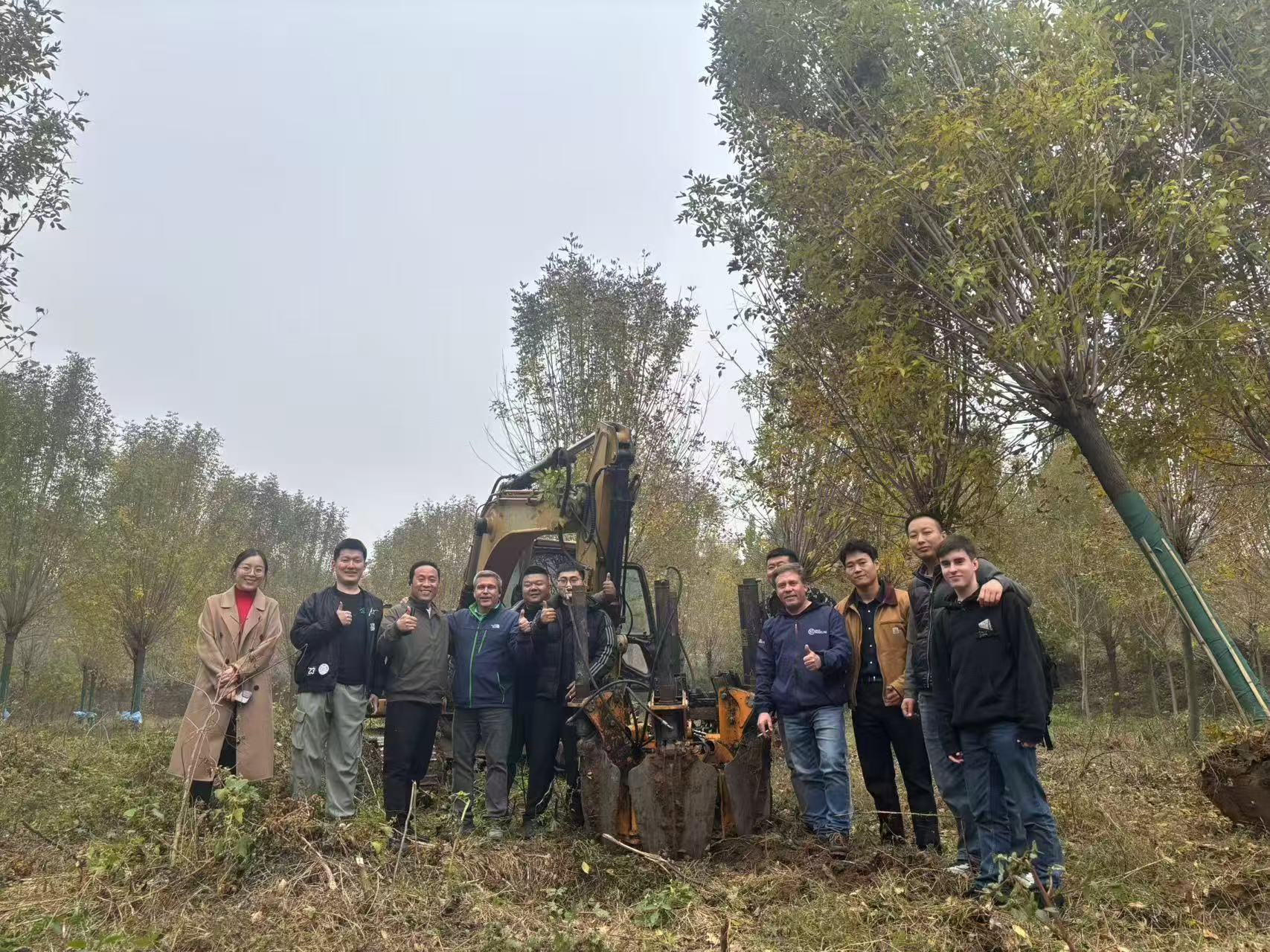
A large landscaping company undertook a city road greening and park seedling planting project, needing to transplant Platanus trees, crabapples, red maples, and other landscape seedlings with trunk diameters of 6–18 cm. The schedule was tight, and traditional manual crews could not meet the progress requirements.
The project introduced multiple hydraulic tracked tree diggers for centralized seedling digging at the nursery. On-site performance was as follows:
1. Standardized cutting, high soil ball integrity
The four-petal curved tree digging blade cuts simultaneously, forming a neatly rounded soil ball in one go, tightly compacted and retaining fine roots completely, greatly improving seedling survival rates and significantly reducing future maintenance costs.
2. Work efficiency multiplies
Skilled operators can dig a single large tree in just tens of seconds, stable and efficient for continuous operation. One tree digger can do the daily work of 8–10 workers, providing a clear advantage for large-scale projects.
3. Tracked chassis adapts to complex nursery environments
Widened rubber tracks increase ground contact area, preventing sinking in wet and soft soil after rain. The machine is flexible in tight spaces between trees and can also operate steadily on slopes and hilly nurseries.
4. Versatile machine expands usage scenarios
Besides conventional soil-ball tree digging, attachments can be switched to dig holes, cut roots, or clear shrubs. During idle periods, it can also be used for site clearing or landscaping, improving overall equipment utilization.
Actual project benefits
1. Controllable schedule
Mechanized centralized digging allows large numbers of seedlings to be excavated and loaded in a short time, ensuring on-time delivery of greening projects.
2. Improved seedling survival rate
Intact soil balls protect native roots, reducing transplant losses and minimizing additional seedling replacement costs.
3. Long-term labor cost savings
Reduces reliance on temporary labor during peak season, avoiding labor cost spikes and recruitment difficulties. One-time equipment investment can pay off over multiple years.
4. Standardized construction
Uniform soil ball specifications meet municipal project acceptance standards, making it easier to
Success Case
Doubling garden construction efficiency, a money-making tool
The landscaping and nursery industry has already entered the era of mechanization, and the old manual, rough digging method is slowly being phased out. Hydraulic crawler tree diggers stand out because they're well-built, efficient, and adaptable to different terrains. They're not only suitable for nurseries and municipal greening projects in China but also work well on overseas farms, forestry sites, and landscaping projects. They're the go-to equipment for improving the quality of tree transplantation while cutting costs and boosting efficiency.
Project Details
About This Case
2026-06-14
If you are interested in this solution or have similar needs, please contact our expert team.
Request Quote